
Why seconds only matter at volume
The more complex a turned part, the more of its price is machine time, so the seconds each part spends on the machine set most of its unit cost. Finding those seconds takes a skilled setter’s time and trial runs on the machine. On 200 or 2,000 pieces our priority is to make the part right and keep it stable; the hours spent saving a few seconds would rarely come back, unless the part will be reordered.
From about 10,000 pieces we start reviewing the process itself, and above 20,000 we work on cycle time and quality together, second by second. The arithmetic is simple: 5 seconds saved on 20,000 parts is about 28 machine hours, and 30 seconds on 10,000 parts is about 83. How batch size changes the unit price
Below 10,000 pieces: the most stable method first
The same drawing can be made in many ways: which end is machined first, which hole comes before which feature, how the work is split between operations. We follow a standard process. Below 10,000 pieces we start from the hardest feature, usually the tightest tolerance, and find the most stable way to hold it, even if it is not the fastest. That is the quickest route to parts that pass. The smaller the batch and the harder the part, the more this applies, because the time is short.
An experienced setter then tries the tooling and the operation order until the first parts pass inspection. A simple part can be running in half an hour; a part with several operations can take two days. On a long run, that stable setup is where the cycle-time review starts, not where it ends.
A real example: the end that decided the cycle time
A laser-equipment customer ordered 10,000 C3604 brass brackets, 40 mm long, made on a Tsugami Swiss-type lathe. Through the middle runs a Ø1.2 mm hole close to 40 mm long that meets the milled flats. The small hole, the flats and a larger hole all have to be made in one setup, with both ends concentric. We machine the small hole first, then the larger hole, to keep both ends concentric; with the small hole already in place, the flats come out stable at a faster feed.
The first parts took about 3.5 minutes each. During production we found that the end from which the Ø1.2 mm hole is machined decided the cycle time. After changing the sequence, the cycle settled at 3 minutes: 30 seconds per part, about 83 machine hours over the order, which was delivered in 30 days. Read the full brass bracket case
A second example: from 6 to 3.5 minutes on a thin-walled sleeve
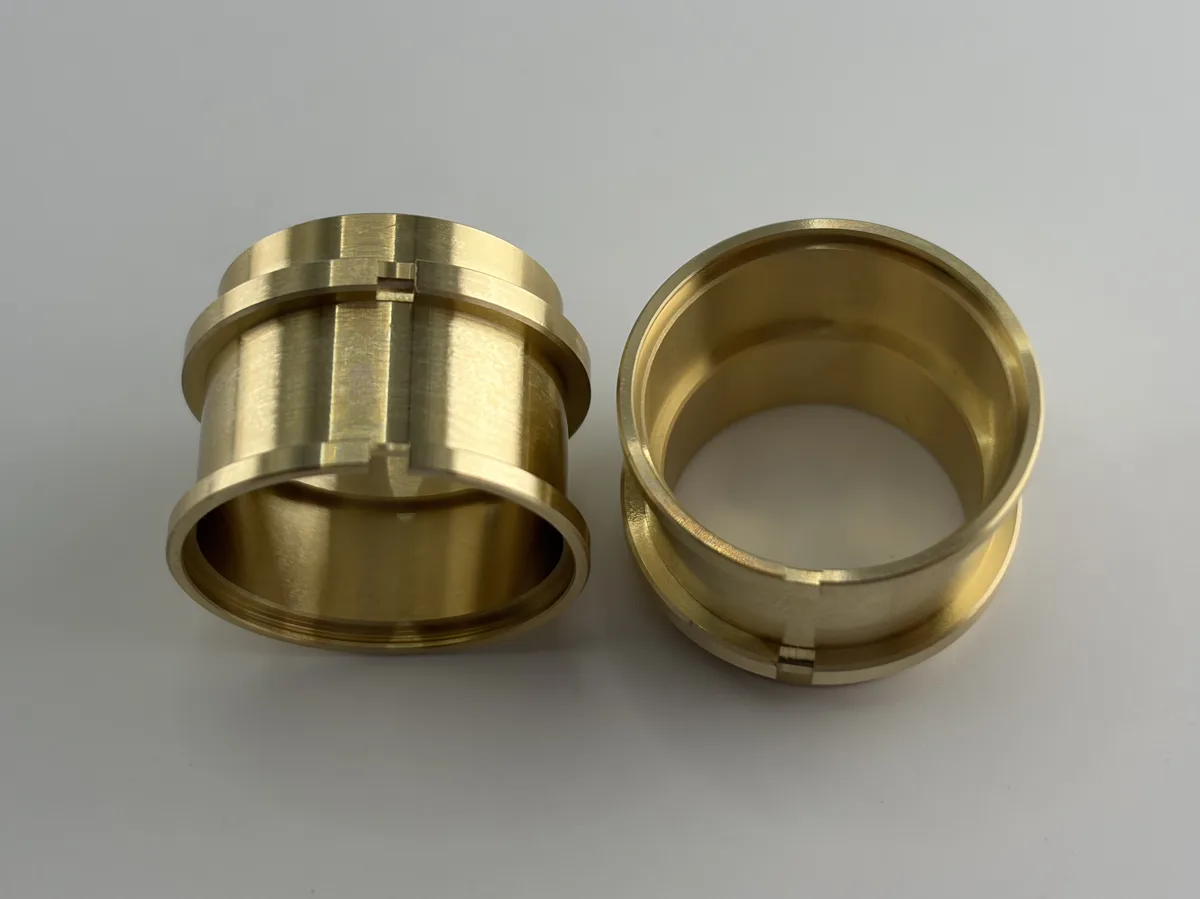
A customer takes 50,000 brass sleeves a month, in C36000 brass with a non-magnetic requirement, made on a mill-turn machine. The wall is thin, and we were worried it would deform. So we started the way we start any hard part: with a slow, safe method that held the precision bore. The first parts took 6 minutes each.
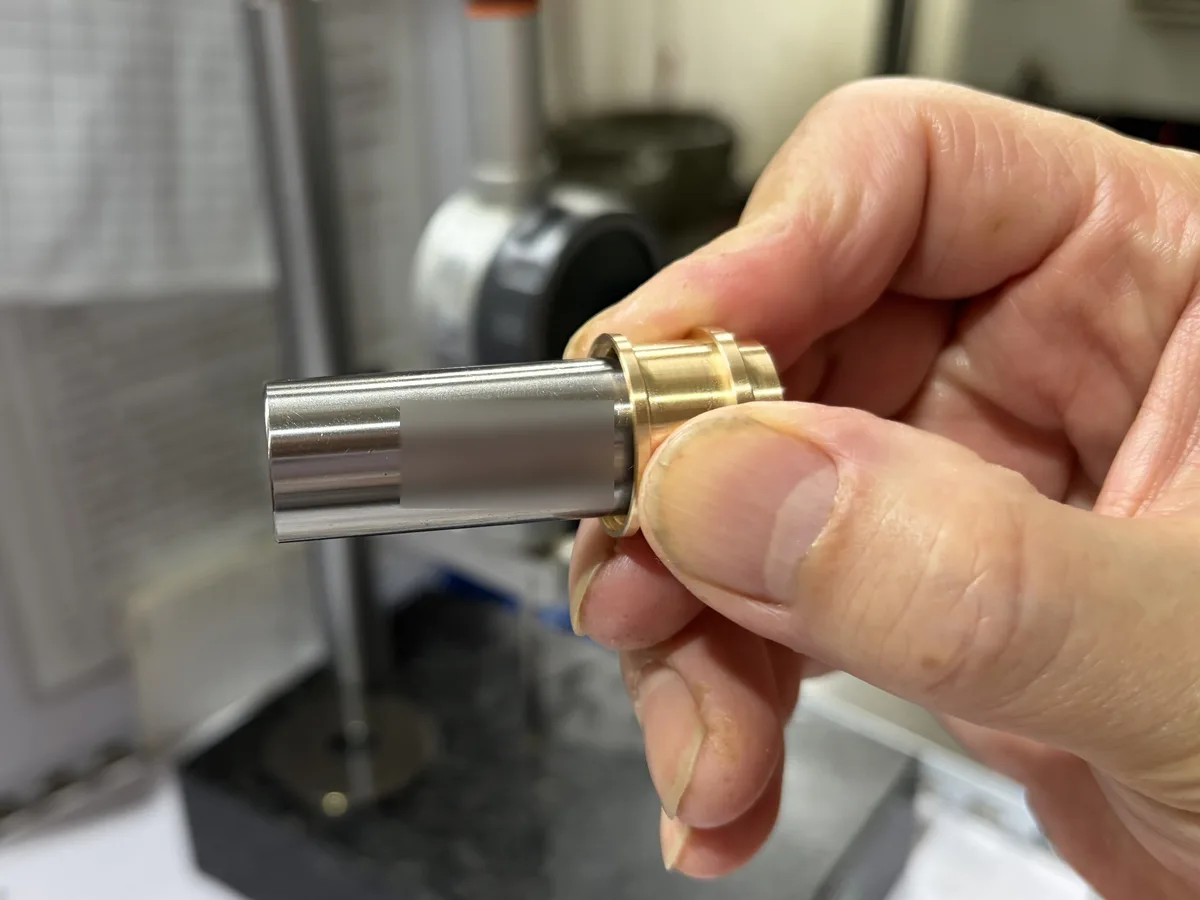
The deformation was solved later, and the key step was agreeing the inspection method with the customer: the precision bore is checked with a plug gauge made to fit it. With that settled, the operator only has to keep the tool’s cut stable, and we could optimise the feed rates in the program and the tooling. The cycle came down to 3.5 minutes: 2.5 minutes saved per part, about 2,080 machine hours a month at 50,000 parts.
Quality is checked while the time comes down
A faster cycle is only worth having if the parts still pass. On the brass bracket the Ø2.00 mm bore was checked on 5 parts every 30 minutes with 2.00 mm go / 2.01 mm no-go pin gauges, and the reject rate stayed below 0.3%.
That is why, on long runs, we treat cycle time and quality as one review rather than two. Every order also starts with a first-article check of every dimension on the drawing before the batch runs. How we inspect every order
What on your drawing moves the cycle time
Three things on a drawing move the cycle time most. Surface roughness sets the feed rate and how much finishing work follows. Each precision dimension needs inspection time, and the more of them there are, the more often we sample. Special requirements need their own control steps, which add handling.
Inspection methods also have to be consistent, and this affects the cycle time a great deal. Agree how each precision dimension will be measured before production starts, so the same method is used throughout; on the sleeve, that agreement is what made the faster cycle possible. And often a single feature drives most of the time, like the small hole on the bracket: when you ask for a quote on a long run, ask the supplier which feature it is.
How to ask for a cycle-time review
Tell us the quantity per release, the expected annual demand and whether the part will be reordered. A single batch of 10,000 and a part that runs 10,000 every quarter justify very different amounts of process work, and we plan the review to match.
Send the PDF drawing with dimensions, tolerances and material, together with the quantities. We send a formal quotation within 1 working day. Send a long-run drawing for review See how our production orders work
Ready to bring it together?
Use the inquiry form to organize your part details and target quantities.
Prepare your inquiryPrepared by NOW CNC for production buyers. Manufacturing scope is defined by the reviewed drawing and accepted quotation.